Agile vs. Waterfall Project Management: 10 Key Differences Explained in 2025
Are you ready to kick off your next software project? Before diving in, choosing the right project management methodology is a decision that can make or break your success. Without a structured approach, projects often face scope creep, missed deadlines, and budget overruns.
Among the most widely used models today are Agile and Waterfall. Each has its strengths, weaknesses, and ideal use cases understanding their core differences can help you select the right strategy for your team in 2025.
What Is Agile Methodology?
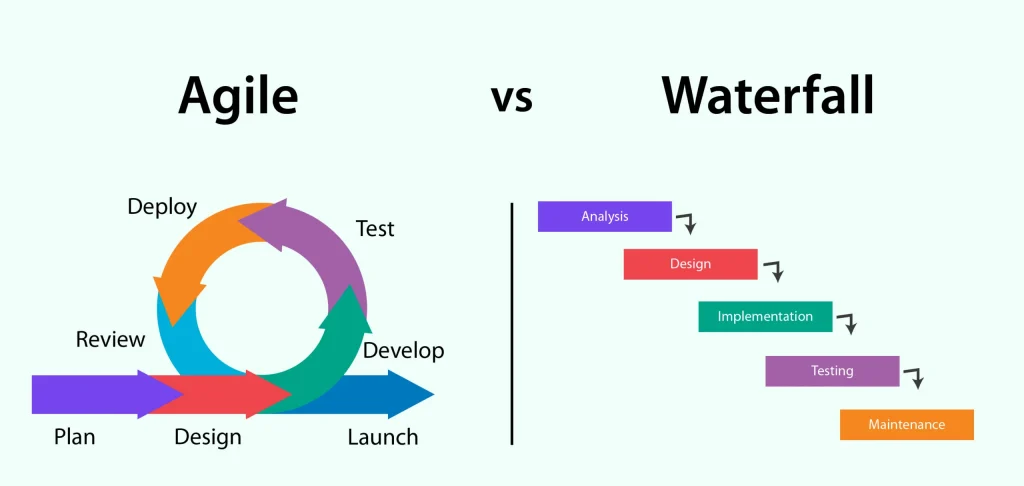
Agile is an iterative and flexible project management approach that thrives in fast-changing environments. It supports incremental development and ongoing collaboration, emphasizing adaptability and rapid feedback.
Popular Agile Frameworks:
- Scrum: Based on time-boxed sprints with regular retrospectives and planning sessions.
- Extreme Programming (XP): Prioritizes customer satisfaction through frequent releases and continuous testing.
- Kanban: Visual workflow system focused on “just-in-time” production and constant improvement.
Pros of Agile:
- High adaptability to changes
- Continuous delivery of value
- Improved transparency and team collaboration
- Customer involvement throughout the project
- Faster time to market for MVPs
Cons of Agile:
- Not ideal for short-term or fixed-scope projects
- Requires disciplined collaboration and communication
- Risk of scope creep
- Demands frequent client input
What Is Waterfall Methodology?
Waterfall is a linear, sequential model where each phase must be completed before the next begins. It’s well-suited for projects with clear goals and fixed timelines.
Typical Waterfall Phases:
- Requirements gathering
- System design
- Implementation
- Testing
- Deployment
- Maintenance
Pros of Waterfall:
- Clear structure with predefined stages
- Easy to manage progress and budget
- Better suited for smaller, predictable projects
- Minimal client interaction after project starts
Cons of Waterfall:
- Inflexible to mid-project changes
- Late-stage feedback only
- Slower to deliver usable product
- Higher risks if initial planning is inaccurate
10 Key Differences Between Agile and Waterfall
| Criteria | Agile | Waterfall |
|---|---|---|
| Approach | Iterative & flexible | Linear & sequential |
| Flexibility | High—changes welcomed anytime | Low—changes after planning are difficult |
| Planning | Continuous and adaptive | Done entirely upfront |
| Delivery | Incremental delivery in sprints | Final delivery at project end |
| Client Involvement | Ongoing collaboration | Initial and final stages only |
| Team Structure | Cross-functional teams | Siloed roles and responsibilities |
| Testing | Continuous throughout development | Occurs post-development |
| Documentation | Lightweight, working software prioritized | Heavy and stage-specific documentation |
| Feedback | Real-time and recurring | After project or phase completion |
| Best For | Complex, evolving projects | Simple, well-defined projects |
When to Use Agile vs. Waterfall?
Use Agile if:
- Requirements are expected to evolve
- Fast MVPs and market feedback are critical
- Clients are highly engaged
- Cross-functional teams are available
Use Waterfall if:
- Requirements are fixed and clear
- Timelines and budgets are non-negotiable
- Client interaction is minimal
- Strong documentation is a priority
Choosing the Right Path with Uway Technology
Selecting the right project methodology is just the beginning. To ensure long-term success, you need an experienced partner who can help you implement your vision, regardless of the model you choose.
At UwayTechnology, we help startups and SMEs build scalable, high-performance software using both Agile and Waterfall models tailored to your business goals and market needs.


